Day trading futures: a beginner’s guide
Start with Moh’s Futures 101 video, then learn NQ and ES contract sizes, margin, orders and session planning through worked examples and original charts.
Day trading futures means opening and closing a futures position within the trading day, rather than keeping it overnight. You trade a standardized contract whose price tracks an underlying market. The contract’s dollar value per point determines how a price change affects your position.
Moh focuses on Nasdaq-100 and S&P 500 futures. This guide starts with those contracts, then connects the mechanics to the preparation, entries and review process shown in his videos. Futures are leveraged products: losses can exceed the money deposited, and a stop order cannot guarantee a maximum loss. CFTC futures risk guidance.
Start with the Futures 101 video
Watch How To Get Started Trading Futures For Beginners, Moh’s 18-minute introduction to ES and NQ. These are the sections to revisit alongside the guide:
- 1:26 — How margin works.
- 2:51 — Mini and micro contracts.
- 4:19 — ES and NQ tick and point values.
- 14:12 — Why low margin can encourage too much size.
The video was published in October 2022. Its broker prices, platform availability and account comparisons describe that period. The sections below use current exchange references. They also clarify a risk point from the recording: a stop can slip or remain partly unfilled, so it cannot ensure the account is protected from a large loss. Tax treatment depends on the product and taxpayer; the recording’s broad comparison is not a tax rule for every viewer.
Learn what NQ, MNQ, ES and MES mean
NQ and ES are CME E-mini futures. MNQ and MES are their Micro E-mini counterparts, with one-tenth the dollar exposure per contract. NQ follows the Nasdaq-100 index; ES follows the S&P 500. These futures have expiration months, so your order ticket must identify the contract you intend to trade.
An index point is a 1.00 change in price. For the outright contracts below, one tick is 0.25 points. Four ticks make one point.
| Contract | Market | Value per point | Value per tick |
|---|---|---|---|
| ES | S&P 500 E-mini | $50 | $12.50 |
| MES | S&P 500 Micro E-mini | $5 | $1.25 |
| NQ | Nasdaq-100 E-mini | $20 | $5 |
| MNQ | Nasdaq-100 Micro E-mini | $2 | $0.50 |
Sources: CME ES specifications, NQ specifications and Micro E-mini specifications. Options and spreads can use different increments.
A hypothetical long in one MNQ contract from 21,000 to 21,010 gains 10 × $2 = $20 before costs. The same ten-point fall loses $20. One NQ changes by $200 over either move. Choosing a micro changes the dollar exposure; it does not change whether your entry is well defined. The NQ versus MNQ guide works through sizing and trading costs in more detail.
Use the futures contract’s own price when calculating a trade. Fixed dollar conversions from SPY or QQQ can become inaccurate as market prices and the relationship between the products change.
Separate margin from the money at risk
Margin is the collateral required to hold a position. It can change with market conditions, the broker and the time you hold the trade. A low intraday requirement does not cap what the position can lose. CME’s explanation of futures margin.
Before an order, calculate the planned price distance to the stop:
Planned price risk = stop distance in points × dollar value per point × contracts.
For a hypothetical 20-point stop, one MNQ has $40 of price risk if it exits exactly at that level. One NQ has $400. Three MNQ have $120. Fees and worse fills add to those amounts. A worksheet returning zero affordable contracts means the proposed trade does not fit the loss allowance entered.
There is no single starting balance that makes futures trading suitable for every beginner. Work through the broker’s current requirements, total costs and the losses a tested plan may incur. Money needed for living expenses does not belong in that calculation. The margin versus risk guide separates margin, account equity and planned trade loss with a worked example.
Set up a practice account and learn the orders
A charting platform displays the market. A broker provides access to the trading account, and a data subscription supplies the feed. Some platforms combine these functions; others connect separate services. Check compatibility, supported contracts, real-time data, commissions and the account’s current restrictions before paying for a setup.
Use a simulated account to learn the controls. Confirm the account indicator before each practice order, especially when a platform can switch between simulation and live trading.
A market order seeks execution at available prices. A limit order sets the worst price you will accept, but may never fill. A stop order activates when its trigger condition is met; what happens next depends on the stop type and platform. A stop-limit may leave you in the position after price trades through it. CME stop-with-protection orders also have execution limits. CME order mechanics.
Practise placing an entry with its intended stop and target, cancelling an unfilled entry, and closing a position. After closing, check that position quantity is zero and no unwanted working orders remain. The futures order types guide walks through that exercise and the limits of linked bracket orders.
Choose a session and check the calendar
NQ and ES ordinarily trade from Sunday evening through Friday afternoon, with a daily maintenance break. Exchange hours, the US cash-stock session and your account’s required close-out time are different schedules. Holidays can change them.
Write down the chart timezone and the session you are studying. A previous-day high based on the full futures session can differ from one based on cash-stock hours. That distinction matters when you compare your chart with a video or a journal entry.
Use the NQ and ES trading-hours guide to match those boundaries, then check the CME holiday calendar and your provider’s notices for the date you intend to trade. Include scheduled economic releases in your preparation; a replay from a quiet session does not establish how orders will fill during a news release.
Build context before choosing an entry
Moh’s later course starts the setup discussion with an objective, which he calls a draw on liquidity. This is a price reference he expects the market may seek, such as a previous-day high. He then looks for an area of interest and lower-timeframe confirmation. His explanation at 2:40:49.
Write down the objective, the area where you would pay attention, and the event that would invalidate the idea. A directional opinion alone leaves the entry undefined. The daily bias and liquidity guide follows his preparation with timestamped examples.
The chart below comes from his longer beginner course. It shows an NQ replay with the original zones, a proposed entry and stop, and an upper target. The later rally is already visible, so it is useful for learning the sequence rather than measuring its success rate.
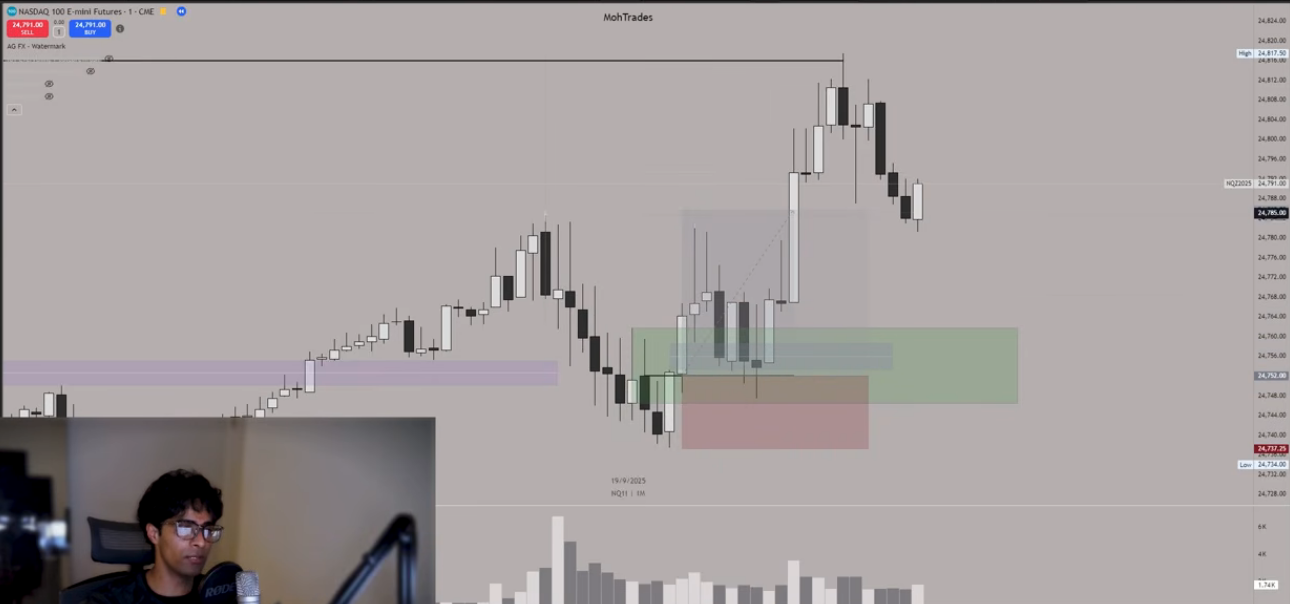
For this example, the review needs to distinguish the higher-timeframe zone from the entry trigger. Moh discusses several possible entries around the same move. Testing a strategy requires choosing one rule consistently before revealing the outcome.
Define the stop, target and reasons to pass
For each proposed trade, record the entry condition, invalidation price, intended target and contract quantity. Calculate the dollar exposure before placing the order. If a target has already been reached before the entry appears, the original opportunity may have ended.
Moh’s recorded NQ short provides another example. He compares NQ with ES, waits for a confirming close, and uses a nearby opposing zone as the target. His explanation uses a 13-point stop. That distance would represent $260 per NQ or $26 per MNQ before costs if filled exactly, regardless of the margin needed to open the position.
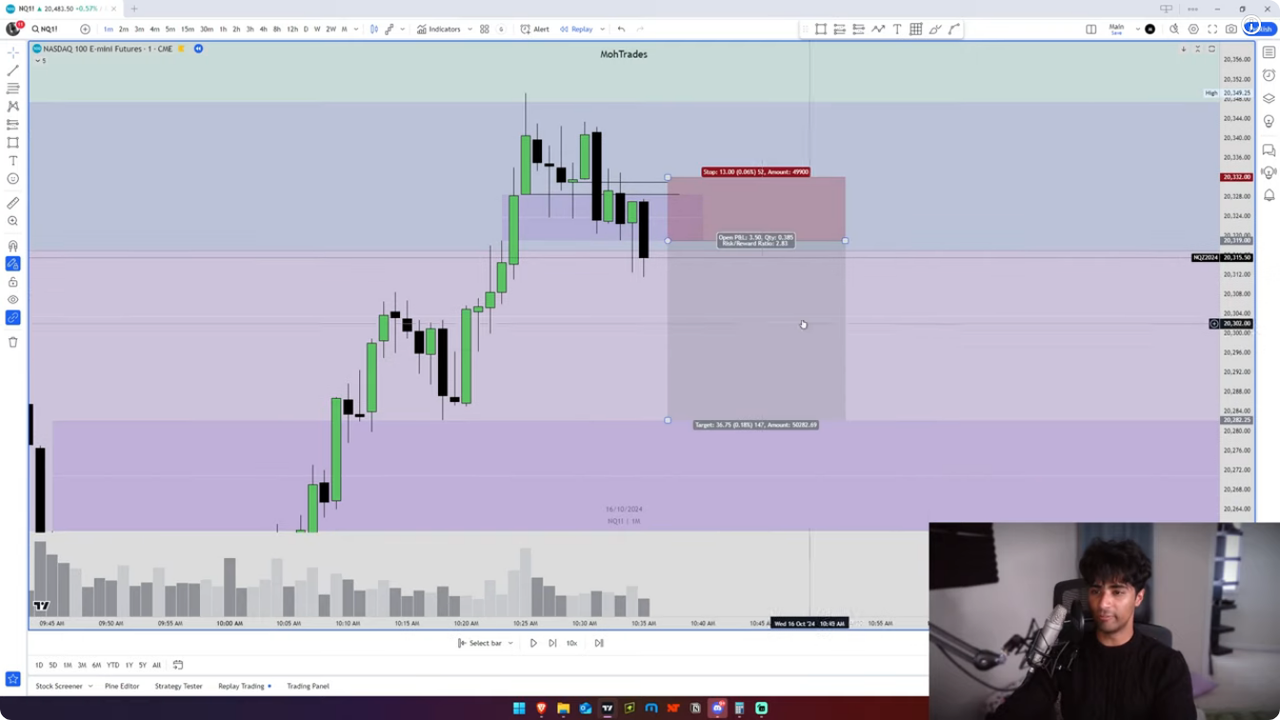
Passing is also a decision to record. In another breakdown, Moh rejects a sell signal because the context is unclear, even though the move later works. The guide to skipping trades explains that example and other conditions that end a setup. A later winning candle does not prove that entering was justified with the information available earlier.
Review a sample before drawing conclusions
Begin with one market, a defined session and one written setup. In replay, hide future candles and save the chart at the decision time. Keep trades that lose and sessions where the setup never appears in the record.
Your journal should let you reconstruct what happened:
- The actual contract month, chart timezone and session.
- The context, entry rule, stop, target and quantity decided beforehand.
- Execution prices, commissions and other costs, with simulated fill assumptions identified.
- Changes to the order or stop, including the event that prompted each change.
- Whether the trade met the rules, even if its result was disappointing.
Calculate results after costs across the sample, including the average win, average loss and sequence of drawdowns. Do not select a method because a few chart examples look profitable. Keep some unseen dates for testing after the rules are fixed; repeatedly tuning a method to the same history can make a weak approach look stronger.
Simulation helps you practise decisions and order handling. It does not reproduce every live fill or the pressure of risking money. The backtesting guide explains how costs and the sequence of trades affect an account, including why a profitable ending can hide an earlier rule breach.
Understand prop accounts before buying an evaluation
A brokerage account and a prop-firm evaluation have different contracts and restrictions. An advertised evaluation balance is not necessarily money you own or can withdraw. Accounts may be simulated, with payouts governed by the provider’s agreement.
If you choose to investigate one, compare its actual loss allowance, daily limits, permitted contracts, fees and payout conditions. The end-of-day drawdown guide shows why the remaining distance to a loss floor matters more than an account’s headline size.
You can learn contract mechanics and practise an order workflow before purchasing an evaluation. Start with the Futures 101 video, then use the order practice exercise to check that you understand what each control does.
Exchange references checked October 25, 2026. Video examples retain their original dates. These educational examples do not establish a profitable strategy or an appropriate risk budget for an individual.
Keep the conversation going.
Bring your questions to Discord, or follow my market sessions on YouTube.